|
In the 1930's and 1940's, large
hand-held cameras such as the Speed Graphic 4x5 and 3¼x4¼ cameras were
extremely popular with professional photographers. It was natural for
the Simmon Bros. to expand the Omega line to accommodate these formats,
and so the Omega C and D models were developed.
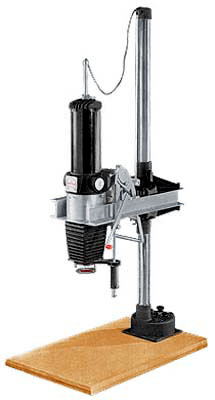
These larger format enlargers were designed
along the same lines as the successful A and B enlargers, with a long
upright tubular column and the projector assembly supported by cast
aluminum beams on either side. To ensure efficient light output for
different negative formats, the C and D enlargers featured
interchangeable condenser sets, in addition to which the position of the
lamp could be adjusted. On the Omega D, a rheostat at the base of the
column could be used to adjust the light output. The tall lamphouse
barrel was made of bakelite, between top and bottom aluminum castings.
Unlike the smaller Omegas, the C and D had pleated bellows, but the
focusing was still by lever, rather than a knob. The D series enlargers
that followed were very different in design, but the one thing the Omega
D has in common with later Omega 4x5 enlargers is the standard 6½"
condenser set.
While the C and D were designed to
provide the features that the professional would want, they were of
limited appeal to the amateur market because of their height. The C had
a 48" column; the D was 60". The tall columns allowed for huge
enlargements, but with the additional height of the lamphousings, in
order to raise the head to the top of the column, the user required an
extremely high ceiling! Although they sold reasonably well, the C and D
were soon replaced by the C-II and D-II models. |