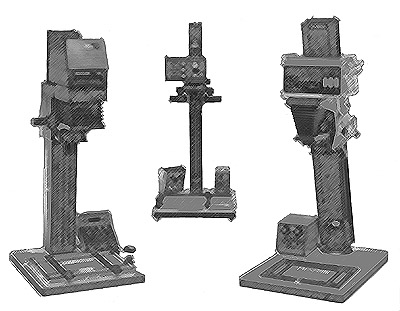
Current Enlargers


Click on a thumbnail below to view larger picture and data.

C700 Enlarger
C700

D5XL Variable Condenser Enlarger
D-5XL

Super Chromega E Dichroic II
Chromega E

Super Chromega F Dichroic II
Chromega F


The Omega Story


In 1935, small format cameras such as Leica and Contax were becoming quite popular. Young Fred Simmon believed that there was a market for a domestic enlarger for the 35mm format to compete with the Leica. He enlisted his two older brothers, Rudolph and Alfred, to join him in a venture to produce a new enlarger.

"The Complete Enlarger"Alfred was then employed as an engineer with Westinghouse, and did the design work of the enlarger at night and on weekends. Simmon Bros. first enlargers were ready to sell in the spring of 1936. The initial product was quite ambitious - a 35mm enlarger, complete with 8x10 easel, safelight, timer, and focusing magnifier, that folded up into a compact carrying case.  Looking for a trademark for their products, they felt the Greek letter Omega sounded good and would make a suitable logo, and registered it with the Patent Office. 

That first enlarger, called "The Complete Enlarger," proved to be a little too ambitious, as they found they were losing money on each unit they sold, and quickly set about toThe Omega "B" Enlarger design a less complicated, lower priced unit.  In 1937, they introduced the "Omega B" enlarger, which accepted negatives up to 2¼"x2¼".  Priced at $65.00 without lens, it gained immediate acceptance with dealers and customers, thus assuring the success of the young company. 

In 1938, a 35mm enlarger, the "Model A," based on the design of the "Model B," was added to the line.  By that time, Alfred had been able to leave Westinghouse and join his brothers as an equal partner in the firm.

1939 proved to be another pivotal year for Simmon Bros.  In August of that year, Kodak announced their forthcoming 2¼x3¼ "Precision Enlarger," which boasted more features and accessories than the "Omega B."  The brothers feared that the new enlarger, backed by Kodak's huge marketing and promotional resources, would put them out of business.  With a massive effort, they designed and built the "Super Omega B" enlarger in just three months.  It debuted only a few weeks after Kodak's initial shipments, and sold well enough that Kodak dropped the "Precision Enlarger" after a couple of years.

The Omega "D" EnlargerIn that era, Speed Graphic cameras, using 4"x5" film were the news photographers camera of choice.  It was logical, therefore, for Omega to have an enlarger that would accommodate this film size, so the "Model D" was also introduced in 1939, followed by the famous D-II just two years later.

During World War II, production of enlargers for civilian use was prohibited, so the future of their 20 employees was in doubt.  The company managed to secure contracts with the Army Signal Corp, which helped, but did not fully occupy the workforce.  They then approached and were welcomed by the U.S. Navy to produce 5"x5", 7"x7" and 10"x10" enlargers. Additionally, the company was commissioned to design a 2¼"x3¼" pack film camera to meet Navy requirements for combat conditions.  The experience gained on this project eventually led to the production of what became the Rapid-Omega roll film camera, which introduced the 6x7cm format.

The Simmon Bros. factory was in an ideal position to quickly resume production of consumer enlargers after the war, and found that the largest market was now for 4x5 enlargers, primarily due to returning GIs who had worked in darkrooms during the war. 

The Omega factory continued to thrive during the 1950's, introducing a series of "B" enlargers with additional refinements, including autofocus enlargers.  By the 1960's Rudolph and Alfred were in their '60s, and the brothers looked to assure the future of Omega.  In 1964, therefore, Simmon-Omega became a division of Berkey Photo. 

It was during this period that the company benefited from a major boom in interest in photography.  The 35mm SLR, with built-in metering systems simplified the process of achieving quality photographs and widened the appeal of photography as a hobby.  The introduction of colorhead enlargers and color processing drums enabled anyone to process their own color enlargements.  As a result, the sales of darkroom equipment skyrocketed as well.  This enabled Omega to introduce a number of new models during the 1970's and 80's including the D5, C67, B66, B600, C760 and D5500.

Inevitably there was a downturn.  The introduction of one-hour photo labs, video cameras, point-and-shoot 35mm cameras, and later, digital photography, all have had an effect on enlarger sales.  The darkroom market declined as hobbyists moved to other interests.  In the late 1980s, Berkey Photo experienced financial difficulties and went into bankruptcy.  Omega was subsequently purchased by the RT Corporation to become RT/Omega.  There were more changes as the company attempted to deal with the changing market.  It become Omega International, then Omega/Arkay. In 1995, Arkay was released and Omega purchased the Satter Corporation to form the current company, Omega/Satter. 

The Simmon brothers are gone now, but their legacy survives in the Omega enlargers being sold today.


Copyright © 2002 - 2005 KHB Photografix  All rights reserved.